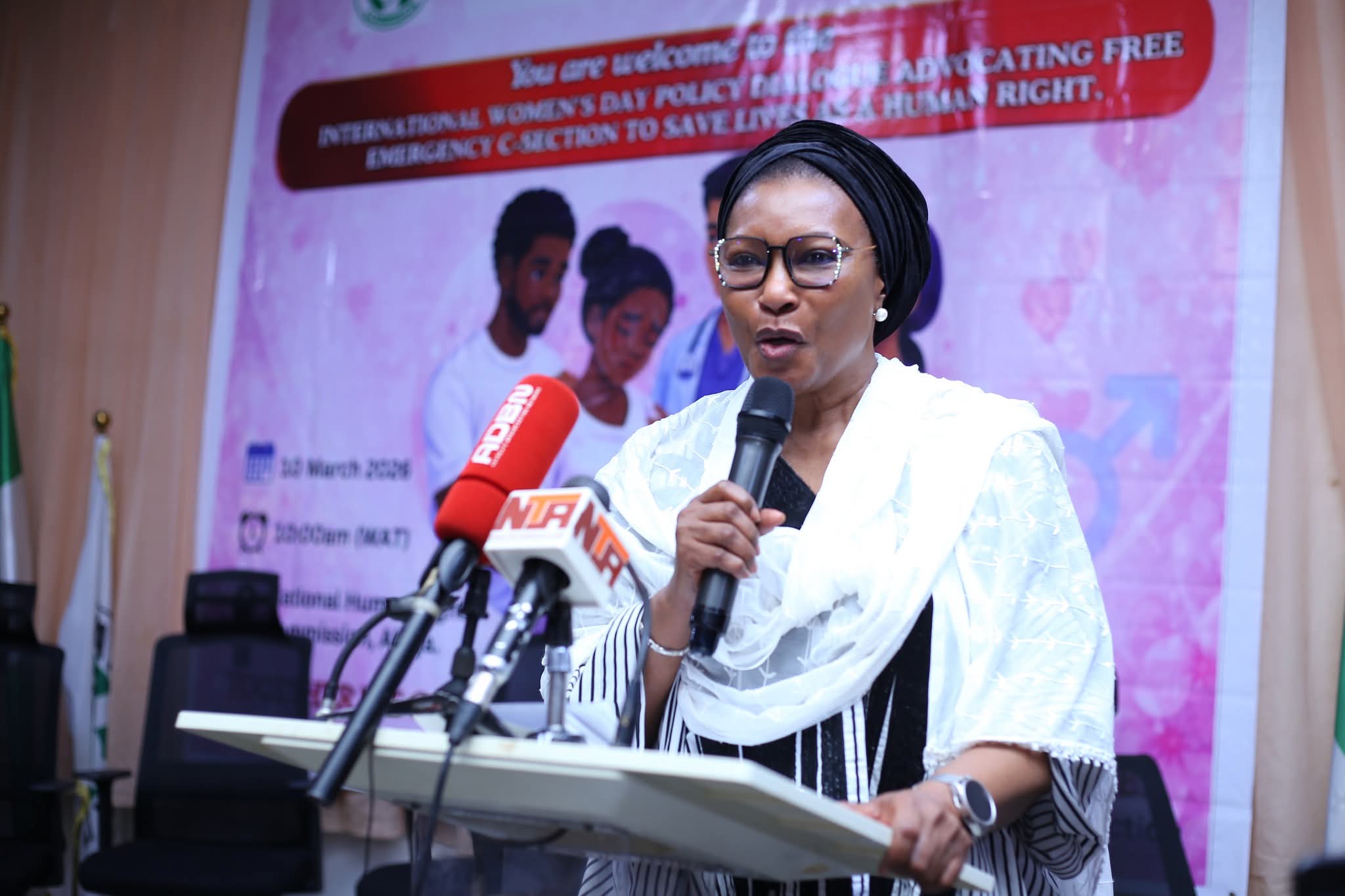
The Chairperson of the Senate Committee on Women Affairs, Ireti Kingibe, has stated that maternal health is not a privilege but a fundamental human right.
Senator Kingibe made this assertion during the International Women’s Day Policy Dialogue organised by Adinya Arise Foundation in partnership with the National Human Rights Commission at the Commission’s auditorium.
According to the senator, the health of a nation is measured by how it treats its women in their most vulnerable moments.
She noted that Nigeria contributes nearly 28.5 percent of global maternal deaths, emphasizing that the figures represent real lives lost.
“This is not just statistics; it is a teacher, a sister, a daughter, and a pillar of a home gone forever,” she said.
Senator Kingibe explained that most maternal deaths are linked to the three-delay model: delay in seeking care, delay in reaching a health facility, and, most tragically, delay in receiving care due to the inability to pay.
She added that when labour becomes obstructed or complications arise, a cesarean section is often the only bridge to survival, yet many Nigerian women cannot afford the procedure.
The senator stressed the need for the country to move beyond affordable healthcare to guaranteed free emergency obstetric care.
She therefore urged policymakers and stakeholders to invest in a free C-section programme and ensure that no woman’s life hangs in the balance while waiting for financial clearance.
Kingibe also highlighted the importance of fully funding social welfare units in public hospitals to support vulnerable women.
In his remarks, the Executive Secretary of the National Human Rights Commission, Tony Ojukwu (SAN, OFR), stated that women’s rights are human rights and that healthcare is a fundamental entitlement that must be enjoyed without discrimination.
Dr. Ojukwu asserted that reproductive rights are a crucial aspect of women’s empowerment, noting that access to emergency obstetric care, including cesarean sections, is a critical component.
According to him, Nigerian women face significant barriers to accessing quality healthcare, resulting in unacceptably high maternal mortality rates.
He noted that many women die or suffer severe health complications due to lack of access to emergency C-sections.
“This is a human rights issue, a public health crisis, and a development challenge,” he said.
The Executive Secretary added that advancing free emergency C-section care is not merely a health intervention but a human rights imperative.
By removing financial, geographical, and social barriers, he said Nigeria can protect women’s rights to life and health, promote gender equality, and move closer to achieving United Nations Sustainable Development Goal 3.
Earlier, the convener of the International Women’s Day Policy Dialogue and Executive Director of Adinya Arise Foundation, Mabel Adinya Ade, said that every day in Nigeria women die while performing one of life’s most sacred acts—bringing life into the world.
Mrs. Ade lamented that too many women cannot access timely and lifesaving emergency care when complications arise.
According to her, access to healthcare is shaped by layers of social and systemic barriers.
She noted that many women travel long distances, often across difficult terrain, before reaching a clinic or hospital.
The convener explained that delays in attending to women in labour worsen conditions such as obstructed labour, which can escalate into life-threatening emergencies.
These complications, she said, can lead to uterine rupture, severe bleeding, infection, stillbirth, or lifelong injuries such as obstetric fistula.
Mrs. Ade emphasized that when timely emergency obstetric care, especially cesarean sections, is accessible and delivered without delay, lives are saved.
She stressed that no woman should lose her life simply because she cannot afford emergency childbirth care.